Visualizzazione post con etichetta ripresa economica. Mostra tutti i post

martedì 19 marzo 2019

I VANTAGGI DI ESSERE IN GUERRA (invece che nell’euro)

di Maurizio Blondet

 Abbiamo perduto il 25%  delle industrie.

E la gente non lo sa.  Fossimo stati in guerra,si vedrebbero le macerie  ingombrare le strade,  le fabbriche diroccate, i macchinari perduti  e si capirebbe:  “La situazione è grave, la patria è in pericolo”.
Lo stato di guerra – io l’ho visto in Croazia e a Sarajevo –   instilla  nella popolazione  la  condizione di “mobilitazione”  psicologica:  la società si fa’ più compatta nel pericolo comune.   “In tempo di guerra, ogni cittadino  avverte la scarsezza delle sue possibilità individuali, la drammatica ristrettezza sua,    e la sua radicale dipendenza  dalle capacità di tutti gli altri; la sua sensibilità per il tutto sociale si fa più acuta;  ansiosamente e con non poco sforzo passa in rivista  quel che possa  sperare dalle altre classi e professioni,   quali eccellenze sulle quali possa basare  la prospettiva di vittoria”.
Fossimo in guerra, tutti sentirebbero come una fortuna avere  ancora una grande acciaieria

martedì 8 maggio 2018

Bangladesh. Cina ed il ponte sul Padma. (Sempre attivi , i cinesi)

Giuseppe Sandro Mela.

2018-05-07.

Bangladesh. 001

Il Bangladesh è un paese disperatamente povero. Disperatamente.

Tuttavia qualcosa sembrerebbe iniziare a muoversi.

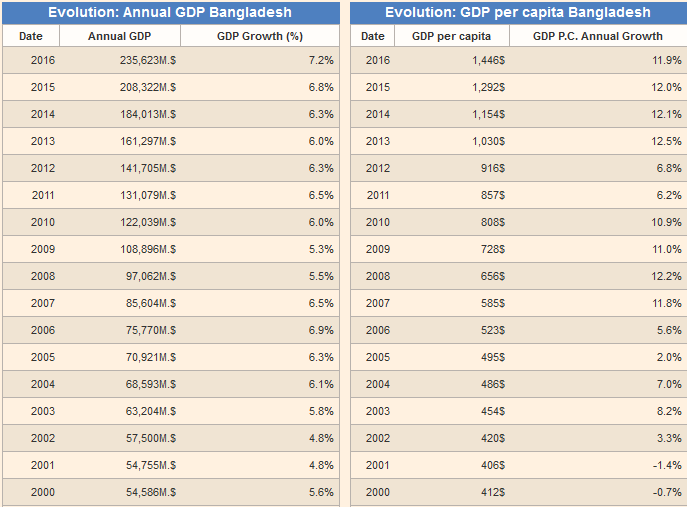
Se nel 2000 il pil procapite era 412 Usd, a fine 2016 era salito a 1,446. Negli ultimi cinque anni il pil è cresciuto al ritmo di qualcosa di più del 10% all’anno.

2018-05-05__bangladesh__001

«On 4 October 2000, the Government of Bangladesh issued a postal stamp marking the 25th anniversary of the establishment of Bangladesh-China diplomatic relations. By this time, China had provided economic assistance totaling US$300 million to Bangladesh and the bilateral trade had reached a value mounting to a billion dollars. In 2002, the Chinese Premier Wen Jiabao made an official visit to Bangladesh and both countries declared 2005 as the “Bangladesh-China Friendship Year.” ….

The two countries signed nine different bi-lateral agreements to increase there mutual relationship. ….

On Bangladesh Nationalist Party PM Begum Khaleda Zia’s invitation China was added as an observer in the South Asian Association for Regional Cooperation (SAARC). After Cyclone Sidr hit Bangladesh in 2007, China donated US$1 million for relief and reconstruction in cyclone-hit areas. ….

Bangladesh is third largest trade partner of China in South Asia. But, the bilateral trade between them is highly tilted in favour of Beijing. Bilateral trade reached as high as US$3.19 billion in 2006, reflecting a growth of 28.5% between 2005 and 2006. China has bolstered its economic aid to Bangladesh to address concerns of trade imbalance; in 2006, Bangladesh’s exports to China amounted only about USD 98.8 million. Under the auspices of the Asia-Pacific Free Trade Agreement (AFTA), China removed tariff barriers to 84 types of commodities imported from Bangladesh and is working to reduce tariffs over the trade of jute and textiles, which are Bangladesh’s chief domestic products. China has also offered to construct nuclear power plants in Bangladesh to help meet the country’s growing energy needs, while also seeking to aid the development of Bangladesh’s natural gas resources. China’s mainly imports raw materials from Bangladesh like leather, cotton textiles, fish, etc. China’s major exports to Bangladesh include textiles, machinery and electronic products, cement, fertiliser, tyre, raw silk, maize, etc» [Fonte]

*

Bangladeshi, Chinese firms sign joint venture pacts to build railway

«Two Bangladeshi and two Chinese firms have signed two joint venture pacts to build over 100 km rail lines and required infrastructure in the country’s southeastern Cox’s Bazar district bordering Myanmar.

Officials of Bangladesh Railways and joint venture China Railway Group Limited (CREC) of China and Toma Construction and Company Limited of Bangladesh; and China Civil Engineering Construction Corporation (CCECC) and MAX JV (joint adventure of CCECC of China and MAX international Ltd of Bangladesh) signed the deals on behalf of their respective sides here on Saturday. …. the project is part of the Asian Development Bank (ADB) support»

China EximBank to fund Padma Bridge rail link project

«The Export-Import Bank of China is going to fund the rail connection in Bangladesh’s largest infrastructure project till date, the Padma Bridge. …. Once in operation, it will only take about three and a half hours to travel to Khulna from Dhaka …..

This will help expansion of the transport sector, trade and commerce. This route will also be connected with the trans-Asian railway ….

Project sources said the principal works involve constructing 169 kilometres of main line, 43.33km loop and siding, laying down 215.22km broad gauge rail truck, 23.37km viaduct and 1.98km ramps.

Other works include constructing 66 big bridges, 244 small bridges and culverts, a highway overpass, 29 level crossings, 40 underpasses, 14 new station building, development of six existing stations, and arranging computer-based railway interlock system signalling at 20 stations»

*

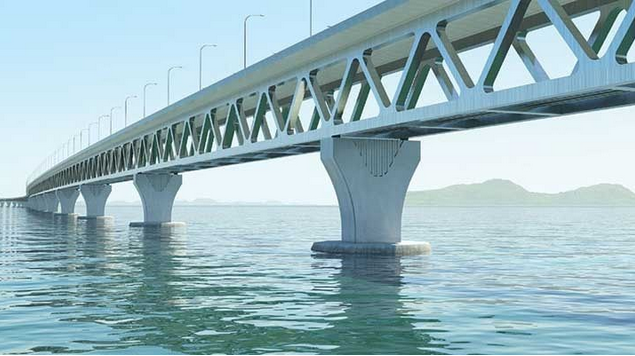
«The Padma Bridge is a multipurpose road-rail bridge across the Padma River under construction in Bangladesh. It will connect Louhajong, Munshiganj to Shariatpur and Madaripur, linking the south-west of the country, to northern and eastern regions. Padma Bridge is the most challenging construction project in the history of Bangladesh. The two-level steel truss bridge will carry a four-lane highway on the upper level and a single track railway on a lower level. With 150 m span, 6150 m total length and 18.10 m width it is going to be the largest bridge in the Pawdda-Brahmaputra-Meghna river basins of country in terms of both span and the total length» [Fonte]

*

Bangladesh. Ponte sul Pdma. 001

Il ponte sul Padma costerà alla fine 3.8 miliardi di dollari americani.

Basta solo guardare la carta geografica per comprendere quanto sia essenziale un ponte degno di tal nome sul Padma, un fiume di portata quasi eguale a quella del Rio delle Amazzoni.

*

Orbene.

Lasciamo i Lettori alla lettura dell’articolo comparso su Project Syndicate.

«To what does Bangladesh owe its quiet transformation? As with all large-scale historical phenomena, there can be no certain answers, only clues. Still, in my view, Bangladesh’s economic transformation was driven in large part by social changes, starting with the empowerment of women.»

Elementare, si direbbe.

Gli investimenti cinesi, strade, ponti, infrastrutture, etc, a ben poco sarebbero serviti, se non quasi a nulla.

È stata la liberazione femminile a generare l’inizio di questa ripresa economica.

Il farsesco è che il Project Syndicate è letto anche in Cina ed in Bangladesh.

*

Una sola domanda.

Il Bangladesh sarà più riconoscente all’Occidente oppure alla Cina?